In Structured Output scenarios, the JSON a model returns sometimes fails to parse: the output is truncated by max_tokens, carries a trailing comma, or is wrapped inside a Markdown code block. The application side usually has to write retry or manual-fix logic to handle this. Structured Output Repair is a Key-level capability, disabled by default. Once enabled, for non-streaming requests that declare structured JSON output, when the JSON returned by the model has format errors, the AIHubMix gateway automatically repairs it into parseable, valid JSON before returning; no client code changes are required.
This switch is disabled by default; when it is off, all responses are returned as-is. The switch is configured independently per Key and takes effect immediately once enabled.

Go to the Key management page to configure

Create or edit a Key and turn on the “Structured Output Repair” switch.
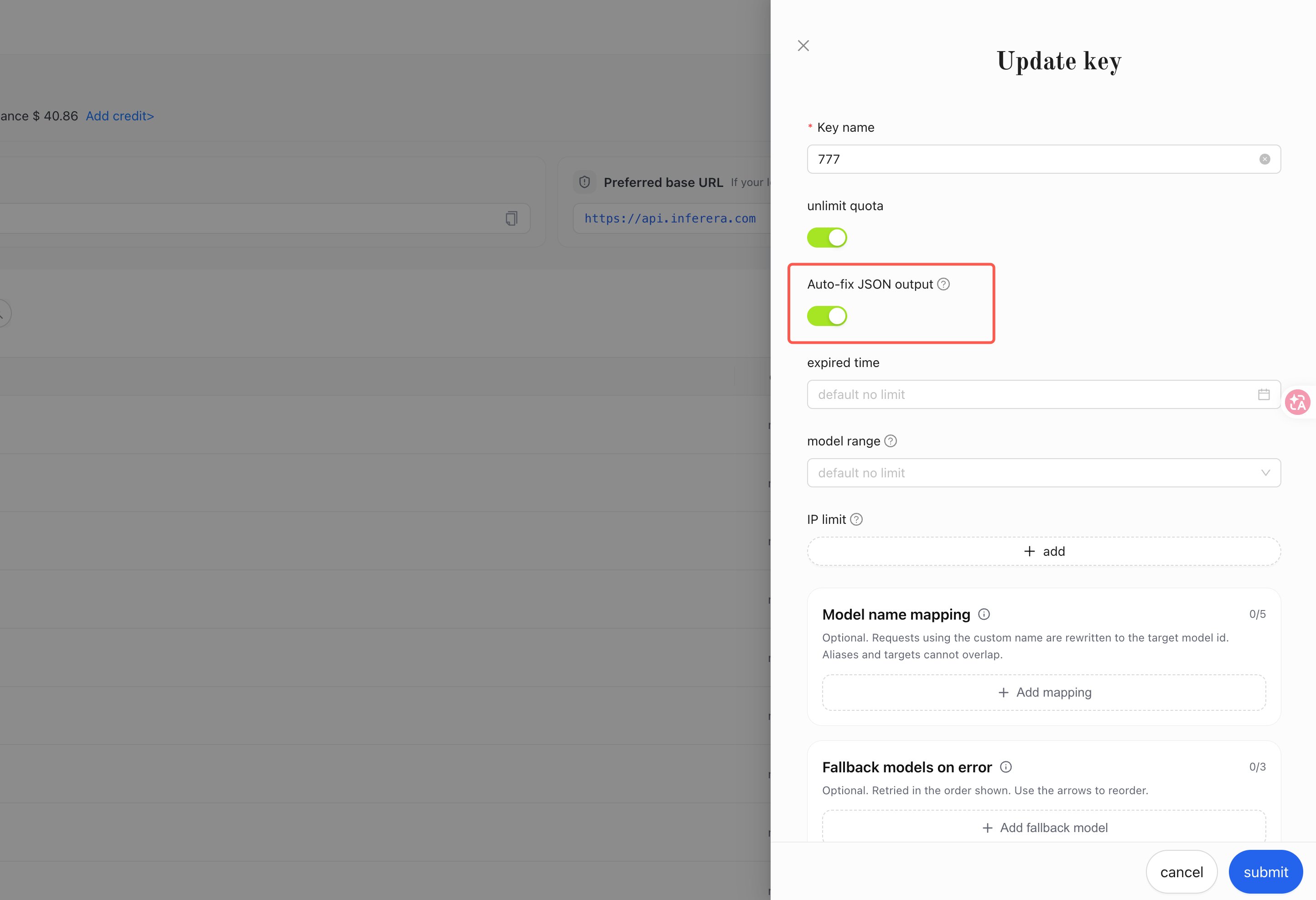
Enabling the Structured Output Repair switch in the AIHubMix edit-Key panel

1. Conditions for it to take effect

Repair happens only when all of the following conditions are met:
  1. The Key used by the request has “Structured Output Repair” enabled.
  2. The request is non-streaming (stream: true is not set).
  3. The request declares structured JSON output (the declaration field for each protocol is listed in the table below).
  4. The text content returned by the model cannot be parsed as JSON.
ProtocolEndpointStructured output declaration field
Chat Completions/v1/chat/completionsresponse_format.type is json_object or json_schema
Responses/v1/responsestext.format.type is json_schema or json_object
Claude Messages/v1/messagesoutput_config.format.type is json_schema
Gemini/gemini/v1beta/models/{model}:generateContentgenerationConfig.responseMimeType is application/json, or responseSchema is set
When the content is already valid JSON, no change is made and it is returned as-is.

2. Repairable format errors

Unclosed brackets / quotes caused by truncated output (e.g. finish_reason is length):
Before
{"items": [{"name": "Widget", "price": 9.99}, {"name": "Gad
After
{"items": [{"name": "Widget", "price": 9.99}, {"name": "Gad"}]}
Markdown code-block wrapping:
Before
```json
{"status": "ok", "count": 3}
```
After
{"status": "ok", "count": 3}
Trailing comma:
Before
{"a": 1, "b": 2,}
After
{"a": 1, "b": 2}
Single quotes:
Before
{'name': 'Widget'}
After
{"name": "Widget"}
Unquoted keys:
Before
{name: "Widget", price: 9.99}
After
{"name": "Widget", "price": 9.99}
Mixed text and JSON (explanatory text before or after the JSON):
Before
Here is the JSON you requested: {"name": "Widget", "price": 9.99}
After
{"name": "Widget", "price": 9.99}
Repair follows a conservative strategy:
  • Repair only completes or normalizes JSON syntax; numeric values and string content keep the original text, with no precision loss or rewriting.
  • The repaired result must be a valid JSON object or array, and its difference from the original must stay within a reasonable range; if either condition is not met, repair is abandoned and the original content is returned as-is.

3. How to tell whether a response was repaired

When repair occurs, there are two programmable / viewable signals:
  1. Response header X-JSON-Repaired: true (this response header is absent when no repair occurs).
  2. Call log note: the note column for the corresponding request on the call log page shows This request gateway automatically corrected the JSON format issue in the model output.
Token usage and billing are calculated from the model’s original output; repair does not change the billing result.

4. Full example

Take generating product information as an example: the request uses json_schema to declare structured output. With the switch enabled, even if the model output has the format errors described above, the content you receive can be parsed directly:
import json
import os
import requests

response = requests.post(
    "https://aihubmix.com/v1/chat/completions",
    headers={
        "Authorization": f"Bearer {os.environ['AIHUBMIX_API_KEY']}",
        "Content-Type": "application/json",
    },
    json={
        "model": "gpt-5.2",
        "messages": [
            {"role": "user", "content": "Generate a product listing for a wireless keyboard."}
        ],
        "response_format": {
            "type": "json_schema",
            "json_schema": {
                "name": "product",
                "schema": {
                    "type": "object",
                    "properties": {
                        "name": {"type": "string"},
                        "price": {"type": "number"},
                        "description": {"type": "string"},
                    },
                    "required": ["name", "price"],
                    "additionalProperties": False,
                },
            },
        },
    },
)

repaired = response.headers.get("X-JSON-Repaired") == "true"
product = json.loads(response.json()["choices"][0]["message"]["content"])
print(product, "repaired:", repaired)
const response = await fetch("https://aihubmix.com/v1/chat/completions", {
  method: "POST",
  headers: {
    Authorization: `Bearer ${process.env.AIHUBMIX_API_KEY}`,
    "Content-Type": "application/json",
  },
  body: JSON.stringify({
    model: "gpt-5.2",
    messages: [
      { role: "user", content: "Generate a product listing for a wireless keyboard." },
    ],
    response_format: {
      type: "json_schema",
      json_schema: {
        name: "product",
        schema: {
          type: "object",
          properties: {
            name: { type: "string" },
            price: { type: "number" },
            description: { type: "string" },
          },
          required: ["name", "price"],
          additionalProperties: false,
        },
      },
    },
  }),
});

const repaired = response.headers.get("X-JSON-Repaired") === "true";
const data = await response.json();
const product = JSON.parse(data.choices[0].message.content);
console.log(product, "repaired:", repaired);
curl -sD - https://aihubmix.com/v1/chat/completions \
  -H "Authorization: Bearer $AIHUBMIX_API_KEY" \
  -H "Content-Type: application/json" \
  -d '{
    "model": "gpt-5.2",
    "messages": [
      {"role": "user", "content": "Generate a product listing for a wireless keyboard."}
    ],
    "response_format": {
      "type": "json_schema",
      "json_schema": {
        "name": "product",
        "schema": {
          "type": "object",
          "properties": {
            "name": {"type": "string"},
            "price": {"type": "number"},
            "description": {"type": "string"}
          },
          "required": ["name", "price"],
          "additionalProperties": false
        }
      }
    }
  }'
To observe a repair on purpose, set max_tokens to a small value (such as 80) so the output is truncated: the response’s finish_reason is length, the content is valid repaired JSON, and the response header carries X-JSON-Repaired: true.

5. Boundaries and notes

Streaming requests (stream: true) are not repaired and are forwarded as-is. When you need the repair capability, use non-streaming requests.
Repair guarantees that the content can be parsed as JSON; data that is missing due to truncation cannot be recovered. We recommend also checking finish_reason / stop_reason, and when the output is truncated, increasing max_tokens as needed and retrying.
  • Syntax repair: whether the field names and field types conform to your schema still needs to be validated on the application side.
  • Tool call parameters are out of scope for repair: the parameter JSON of tool_calls / function_call is not repaired; tool parameters should always be validated on the application side before execution.
  • Multi-text-block output is not repaired: when the model output contains multiple text blocks (for example, Gemini returning multiple parts), it is returned as-is.
  • Reasoning content is unaffected: reasoning text such as reasoning_content and Gemini’s thought part does not participate in repair.

FAQ

Will repair change the numeric values or text in the returned content? No. Repair only completes or normalizes JSON syntax (completing closing brackets, removing trailing commas, normalizing quotes, stripping code-block markers); numeric values and string content keep the original text of the model output. Will enabling the switch affect ordinary requests that do not declare structured output? No. Requests that do not declare structured output fields such as response_format, as well as all streaming requests, have their responses returned as-is. Will repair incur extra billing or change token usage? No. Token usage and billing are calculated from the model’s original output, and the repair process incurs no extra charges. Is the repaired JSON guaranteed to conform to the schema I defined? Repair guarantees that the content can be parsed as JSON; whether the field names and field types conform to the schema depends on the model output itself, so we recommend keeping schema validation on the application side.